Symbol of Family Vietnamese Family in Inside Out and Back Again
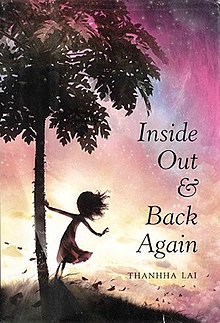 Front cover of the book | |
| Author | Thanhha Lai |
|---|---|
| Cover creative person | Zdenko Bašić, Mauel Šumberac, Ray Shappell |
| State | Usa |
| Language | English language |
| Genre | Historical Fiction |
| Published | September 22, 2011 |
| Publisher | HarperCollins |
| Media type | Print (hardcover) |
| Pages | 260 |
| ISBN | 978-0-06-196278-3 |
| OCLC | 606403465 |
Within Out & Back Again is a verse novel past Thanhha Lai.[1] The book was awarded the 2011 National Book Award for Young People's Literature[2] and one of the two Newbery Honors.[three] The novel was based on her offset twelvemonth in the United States, every bit a ten-year-old girl who spoke no English language in 1975.
Plot summary [edit]
Inside Out and Back Once more is a story about a immature girl named Kim Hà and her family, consisting of her Mother and three brothers, beingness forced to move to the United States because the Vietnam War had reached their habitation state, and it was no longer condom. They board a navy transport and abscond. Upon spending a couple months at a refugee camp, they end up moving to Alabama. In that location Hà struggles with learning English and confronting bullies, including one that she nicknamed Pink Male child, at her new school. Hà at i bespeak said, "No one would believe me but at times I would choose wartime in Saigon over peacetime in Alabama."[four] Eventually, she has pushed through those hard times with the help of their next door neighbor, Mrs. Washington and the back up of her family. In the starting time of the book, it mentions that Hà'southward father, a soldier in the Vietnam war, was captured by the North Vietnamese Army when she was just a year old. In the end, Hà's family figures out that unfortunately, her father had died while in N Vietnamese hands. Hà and then gets used to living in the U.S and her family celebrates the new year. She prays for good things to happen to her and her family.
Origin [edit]
Thanhha Lai had been struggling for fifteen years in gild to accurately describe Hà'south journey from Vietnam to the Us considering Hà'south journey was special—the fictional character was based on Lai's ain feel at the terminate of the Vietnam State of war. In lodge to avoid embellishing on her memory and risking the ire from the family who was there with her, Lai decided to tell the story of Hà instead. She attempted prose from the commencement person and the short, detached way of Hemingway. In the terminate, Lai used complimentary verse because "these phrases reflected what Vietnamese sounded like.".[5]
Critical reception [edit]
Jennifer Rothschild described "Each passage is given a date so readers tin can hands follow the progression of fourth dimension. Sensory language describing the rich smells and tastes of Vietnam draws readers in and contrasts with Hà'south perceptions of bland American food, and the immediacy of the narrative will appeal to those who practice not usually enjoy historical fiction." Publishers Weekly claimed that "Lai gives insight into cultural and physical landscapes, as well as a finely honed portrait of Hà's family as they face difficult choices ... finally regains academic and social confidence. An incisive portrait of human resilience."[6]
References [edit]
- ^ "Thanhha Lai - About the Writer". HarperCollins Publishers. Retrieved 1 March 2012.
- ^ "2011 National Book Award Winner, Immature People's Literature". National Volume Foundation. Retrieved 1 March 2012.
- ^ "2012 Laurels Books". American Library Clan. 1999-11-thirty. Retrieved 1 March 2012.
- ^ "About the Book Inside Out and Back Again". HarperCollins Publishers. Retrieved 1 March 2012.
- ^ Lai, Thanhha (2013). Inside Out & Dorsum Again. New York: Harper Collins. ISBN9780061962790.
- ^ Reviews, Riverside Public Library
External links [edit]
- http://world wide web.harpercollinschildrens.com/books/Inside-Out-Back-Again-Thanhha-Lai/
- Inside Out & Back Again at Google Books
Source: https://en.wikipedia.org/wiki/Inside_Out_%26_Back_Again
0 Response to "Symbol of Family Vietnamese Family in Inside Out and Back Again"
Post a Comment